Author: Andreas Geh

Business Consulting

Business consulting refers to the professional advisory services provided to organizations with the goal of improving their performance, competitiveness, and long-term viability.

Business consultants bring external expertise, proven methodologies, and an objective perspective to help organizations analyze challenges, design strategies, and implement sustainable solutions.

Key areas of business consulting include strategy and business model development, process optimization, digital transformation, organizational development, and change management.

Effective consulting goes beyond analysis – it involves collaborative implementation, working closely with leaders and teams to bring strategies to life.

Key Objectives of Business Consulting:

  • Developing viable strategies and future-proof business models
  • Increasing efficiency, innovation, and customer focus
  • Solving operational, structural, or organizational challenges
  • Supporting transformation and cultural change
  • Equipping leaders and teams with tools and methods for success

Business consulting is most effective when it not only provides insights, but also creates measurable, lasting impact – through clarity, collaboration, and practical execution.

Leadership Development

Leadership Development refers to the structured and ongoing process of developing leaders to strengthen their mindset, competencies, and impact in day-to-day leadership.

It encompasses all initiatives aimed at enabling leaders to act not only operationally (e.g., through direction and control) but also transformationally – by providing clarity, purpose, and human connection.

Leadership development is not a one-time intervention but a continuous journey that addresses the evolving challenges of leadership in complex, fast-changing environments (e.g., VUCA or BANI).

Key Objectives of Leadership Development:

  • Cultivating an authentic leadership style
  • Enhancing self-awareness and self-leadership
  • Developing emotional and communication intelligence
  • Strengthening the ability to lead through change
  • Building resilience, decisiveness, and team leadership skills

Common formats include:

  • Modular leadership programs
  • Coaching and peer learning
  • Workshops, case work, and simulations
  • Feedback and reflection tools
  • Digital learning and guided transfer

Leadership development integrates personal insight, behavioral skills, and strategic thinking – providing a foundation for leadership that inspires people and drives sustainable organizational success.

Training

Training is a planned, structured learning process aimed at developing, practicing, and applying specific skills, behaviors, and competencies in a professional context.

The focus is on active skill development, supported by a combination of input, discussion, reflection, and hands-on exercises. Unlike coaching, which centers around self-reflection and personalized development, training follows a didactic, goal-driven approach: knowledge is taught, skills are practiced, and new behaviors are reinforced.

Trainings are typically designed for groups but can also be delivered one-on-one. They are tailored to specific roles or challenges and are designed to help participants achieve defined learning outcomes – for example, in leadership, communication, time management, or methodological competence.

Typical Objectives of Training:

  • Building new competencies (e.g., feedback, delegation, conflict resolution)
  • Applying proven methods and tools in relevant contexts
  • Preparing for new roles or responsibilities
  • Increasing confidence and effectiveness in day-to-day situations
  • Reinforcing targeted behaviors aligned with organizational goals

Common training formats include:

  • In-person workshops or seminars
  • Virtual trainings and webinars
  • Blended learning (combining online, in-person, and self-paced formats)
  • Role plays, simulations, and case work
  • Micro-trainings focused on specific learning objectives

Underlying principle:

Effective training is not just about information transfer – it creates meaningful learning experiences that enable participants to reflect, experiment, and apply what they’ve learned in their own context.

Coaching

Coaching is a personalized, partnership-based development process in which individuals are supported in finding their own solutions to personal, professional, or organizational challenges. It is based on trust, voluntariness, and a clear framework of goals.

At the center is the coachee – with their resources, potential, experiences, and objectives. The coach does not offer ready-made answers, but instead facilitates the coachee’s thinking process through powerful questions, deep listening, structured methods, and respectful challenge.

Unlike consulting, training, or therapy, coaching is grounded in the belief that the solution lies within the coachee. The aim is not to give advice, but to enable new perspectives, overcome internal blocks, and strengthen self-efficacy.

Objectives and Impact of Coaching

  • Gaining clarity in complex or uncertain situations
  • Reflecting on behaviors, motivations, values, and thought patterns
  • Developing personal and professional capabilities
  • Strengthening self-leadership, decision-making, and resilience
  • Supporting transitions and navigating change (e.g., new roles, leadership challenges, conflicts)

Typical Coaching Topics

  • Clarifying roles and leadership identity
  • Career and life planning
  • Personal development (e.g., dealing with pressure, self-doubt, communication)
  • Managing conflicts within teams or with supervisors
  • Navigating and leading change processes

Core Principles of Coaching

  • Voluntariness: Coaching requires a willingness to reflect.
  • Confidentiality: What is discussed in coaching remains confidential.
  • Resource Orientation: Focus is placed on strengths, not deficits.
  • Goal and Solution Orientation: Coaching is driven by clear goals and aims for actionable outcomes.
  • Process responsibility lies with the coach – content responsibility with the coachee.

BANI

BANI World

The BANI world is a more recent framework that expands upon the VUCA model and offers a sharper lens for describing today’s increasingly turbulent and fragile environments. While VUCA (Volatility, Uncertainty, Complexity, Ambiguity) captured the challenges of the early 21st century, BANI reflects a shift toward deeper levels of disruption and emotional strain.

BANI stands for:

  • Brittle – Systems appear strong but break under pressure
  • Anxious – Constant change fuels stress and insecurity
  • Nonlinear – Cause and effect are disconnected or unpredictable
  • Incomprehensible – Information overload makes situations hard to grasp

Where VUCA emphasizes structural volatility, BANI focuses on human fragility and emotional overwhelm.

It challenges leaders to not only manage complexity, but also to create emotional stability, build resilience, and communicate with clarity and empathy.

Leadership implication:

Leading in a BANI world requires more than strategic planning—it demands emotional intelligence, adaptability, and the ability to navigate uncertainty with courage and care.

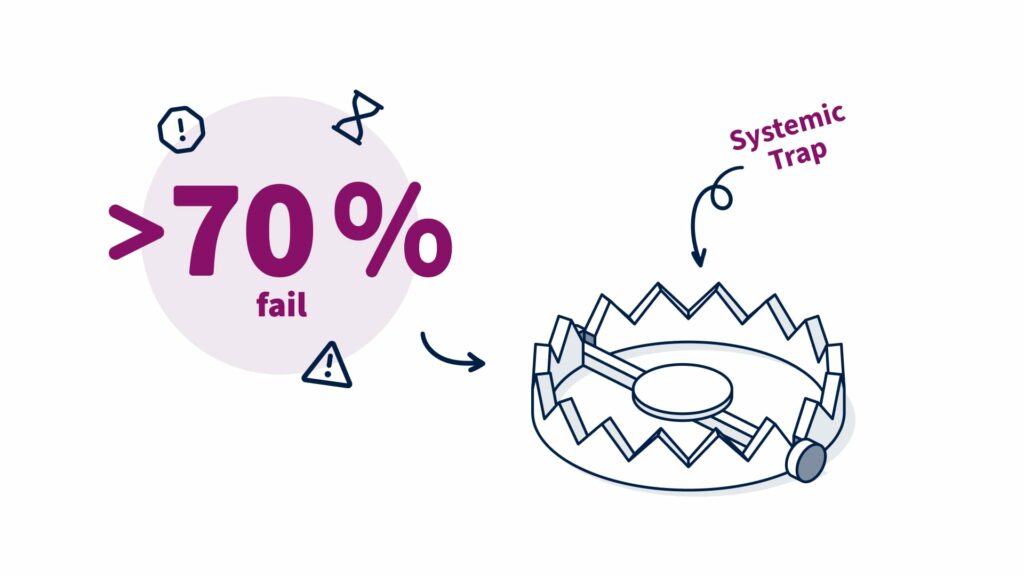
Systemic Trap

The systemic trap describes a common and deeply rooted misconception in transformation processes:

Organizations attempt to drive change primarily through new structures, processes, and systems—assuming that people will automatically adapt once the framework is altered.

When results fail to appear, the typical response is to double down: processes become more detailed, manuals longer, training more intensive—and pressure on employees increases.

The paradoxical outcome: Instead of enabling change, this approach reinforces resistance—often without being noticed. The real blockers don’t lie in the system, but in the emotional experience of the people involved: uncertainty, loss of control, overwhelm.

The systemic trap snaps shut when organizations try to solve emotional dynamics with technical solutions—undermining trust, motivation, and readiness for change.

What it reveals:

True transformation requires more than structure. It requires leadership that provides direction, builds trust, and consciously addresses emotional dynamics.

The Systemic Trap of Transformation: Why 70% of All Change Projects Fail

Transformation is a must today – but many approach it with an outdated mindset. Digital disruption, sustainability, global upheavals: companies plunge into ambitious projects. But studies show: More than two-thirds of all transformations fail.

An indication that 70% of all transformations fail points to a Symbolic Trap - the Systemic Trap

Why?

Through years of working with companies, we’ve observed that leaders often fall for a dangerous misconception: They believe people will change through new structures and processes.

Is it all a big illusion? New processes = new behavior?

The traditional path companies take usually looks like this:

  • Analyze the problems
  • Envision the future
  • Restructure processes, systems, and roles
  • And then? Expect people to simply adapt

The reality: When results don’t follow, companies react in exactly the wrong way: They tighten the process screws, write thicker manuals, double down on training – and increase the pressure.

This is the moment the Systematic Trap snaps shut. Instead of enabling change, companies unknowingly cement resistance.

This is the real reason your people resist and reject transformation.

Change creates uncertainty. And uncertainty triggers something in people far more powerful than any new process description:

We call it Emotional Resistance.

Employees enter:

  • Panic zones: Overwhelm, flight reflexes
  • Defensive zones: Shadow solutions, sabotage

Without targeted leadership, transformation inevitably tips into resistance from this point on.

So what can we learn? What do successful companies do differently?

Systems change nothing – but people change systems.
Anyone who truly wants transformation must reverse the order:

  • First, strengthen leadership and understand emotional dynamics
  • Then adapt processes, structures, and systems
  • Always develop strategy and culture together

Conclusion: Transformation is not an organizational chart redesign – it is a leadership task.

Bottom line: If you want transformation, you must first transform yourself.

The age of planners and process managers is over. The future belongs to those who understand transformation as a living system – and less in a Process management software .

If you still believe that change is just a matter of process quality, you will lose most probably your best people tomorrow.

If you are ready to seriously take on this paradigm shift: Now is the time.

Learn more about the Systematic Trap here: Systematic Trap Video-Series

Empower development. Empower people.

Case-Study

Empower development.
Empower people.

Spanning more than 30 countries, Sobi (Swedish Orphan Biovitrum AB) is an international biopharmaceutical company dedicated to providing access to innovative treatments that transform life for people with rare diseases.

They know that they need to continuously work on developing the spirit of leadership and entrepreneurship to achieve their vision of being recognised as a global leader in rare diseases. They know that to make this happen, they need to encourage every individual in their organisation to be the driver of their own development.

Their goal: To evolve the mindset in the organisation for how they ‘do development’ in Sobi France. To encourage their employees at all levels to take individual ownership for leading and driving their own development.

Overview

“I do not always know what I want, but I do know what I don’t want.” – Stanley Kubrik

In Sobi’s case, they knew exactly what they wanted. The HR Director had also experienced first hand, how our approach can really help to put people into the driving seat of their own development. Naturally, we were delighted when she asked us to help create this same level of understanding and ownership in the organisation.

The first step was to create awareness, which we did with a short key-note, to introduce the idea that development relates more to individual growth rather than being linked to a specific role.

In a second step, we worked with the Leaders and Managers to give them the mindset and the tools necessary to have impactful development conversations with their teams.

The third step was to work with their key talents, to provide a structured approach for them to become ‘creators’ of their own future.

Aligning the Leadership team, all the managers and key talents on development is paramount for me. Everyone now shares the same perspective and language, making development conversations more powerful and ultimately, helping us to be an even higher performing team.

– Sébastien Le Roux, General Manager, Sobi France

Approach

Linking the intervention with the strategy is key:

This ensures that it is given the necessary level of priority and focus, despite people’s ‘busyness’.

Start with the Leaders:

When middle management knows that their bosses at the top of the organisation (including the GM) are going through the same process, it gives the necessary level of coherence and prevents a ‘them and us’ scenario from hampering progress.

Build groups according to seniority:

It’s essential to work with homogenous groups in terms of leadership maturity. This allows the different needs and expectations to be addressed and provides a safe platform for people to express themselves openly and honestly.

Relinking each session to the bigger picture:

Running programms that span over many weeks requires each ‘building block’ to be linked to the next. This creates coherence and builds the interconnections that enable the desired mindset to develop.

Result

Having focused on first developing the necessary mindset with the leaders and managers has elevated the level of leadership across the organisation. A key element for this has been increasing awareness that the role of a leader or manager is not to always have the answer, and that holding development discussions with a coaching approach increases the level of individual engagement and ownership for this in their teams.

Exploring new dimensions of development, such as taking an inside-out rather than an outside-in approach, has opened up the perspective to focus on the development of the individual and their full potential for contribution, rather than just on a person doing a job.

With this approach, their efforts are bearing fruits not only in terms of increased engagement and motivation, but also in supporting each individual’s contribution to the organisation’s strategy and goals, thereby ultimately having the desired impact on helping to transform the lives of people with rare diseases.

Conclusion

For any organization to achieve their vision and strategy, leaders and managers must understand that their role lies not only in ensuring the day-to-day operational activities are well executed. They must also see their role as creating the link for their people between the vision and strategy, and their efforts in the daily operations.

When this is understood, they are able to create a leadership culture that develops and channels the potential of each individual in the organization to contribute to achieving operational excellence and high-performance.

Beyond creating an internal environment, where individuals can flourish and thrive, it creates the organizational stability needed to withstand the everchanging and constant pressures from their external environment.

It allows them to develop the force and power from inside their organisation to foster a culture that is agile and resilient, and in a better position to achieve their long-term vision.

Whether you’re facing major transformation, looking to evolve your leadership culture, or seeking a new strategic direction – we help you shape change with clarity, integrity, and a deep understanding of what drives people.

Appointment Booking

We look forward to getting to know you and your transformation project with all its challenges. Feel free to make an appointment now for a free initial consultation with our Managing Partner Andreas Geh. What you can expect:

  • A 30-minute conversation to find out if and how we can help you
  • A recommendation for your next step (with or without us)
  • An impulse as food for thought

Andreas

Your dialogue partner:

Andreas Geh
Managing Partner

Andreas

Your dialogue partner:

Andreas Geh
Managing Partner

Case-Study Overview

Explore more case-studies

Continue reading

VUCA

VUCA is an acronym to describe or to reflect on the volatility, uncertainty, complexity and ambiguity of general conditions and situations. The U.S. Army War College introduced the concept of VUCA to describe the more volatile, uncertain, complex and ambiguous multilateral world perceived as resulting from the end of the Cold War. It has subsequently taken root in emerging ideas in strategic leadership.

The deeper meaning of each element of VUCA serves to enhance the strategic significance of VUCA foresight and insight, as well as the behaviour of groups and individuals in organisations. V = Volatility: the nature and dynamics of change, and the nature and speed of change forces and change catalysts. U = Uncertainty: the lack of predictability, the prospects for surprise, and the sense of awareness and understanding of issues and events. C = Complexity: the multiplex of forces, the confounding of issues, no cause-and-effect chain and confusion that surrounds organisation. A = Ambiguity: the haziness of reality, the potential for misreads, and the mixed meanings of conditions; cause-and-effect confusion.

These elements present the context in which organisations view their current and future state. They present boundaries for planning and policy management. They come together in ways that either confound decisions or sharpen the capacity to look ahead, plan ahead and move ahead.

From the perspective of organisational transformation, leaders must prepare strategies to lead their organisation through VUCA situations. They must learn to navigate themselves and others, to create an environment of agility, adaptability and development to withstand the pressure of constant change.

Pros

  • Leaders who are proactive in strategic planning can enable their organisations to pre-empt VUCA situations.
  • Leaders who encourage their organisation to learn from mistakes create the conditions for their people to recover from setbacks and look for ways forward.

Cons

  • Organisations must make significant investments in technology to aid collaboration and enable their people in the stormy VUCA environment.

Recommended resources:

VUCA Tools for a VUCA World: Developing Leaders and Teams for Sustainable Results, Deaton Ann V., 2018, ISBN 978-0692074947

Values

Organisational values drive the way people influence, how they interact with each other, and how they work together to achieve results. Organisational values are not descriptions of the work they do or the strategies they employ to accomplish their mission. They are the unseen drivers of behaviour, based on deeply held beliefs that drive decision-making. The collective behaviours of all employees become the organisational culture – “the way we do things around here”.

This promise lies at the core of the organisation’s brand, the essence of its identity, and must be fulfilled by employees.  Those employees who actively fulfil that brand promise, by embracing and living out the organisational values, are the true brand ambassadors. The relative number of brand ambassadors in any organisation is an important indicator of organisational health

Poor alignment between the values of an organisation and the personal values of their employees, translates directly into poor performance. This, in turn, impacts negatively on the quality of deliverables – and the organisation’s financial performance. Conversely, when the values of the organisation are aligned with the personal values of employees, the result will be a high-performance environment with high levels of employee engagement and the pursuit of excellence for the benefit of the organisation.

Most organisations have identified values but for many, they are restricted to wall plaques and induction handbooks, far from the hearts of employees. This disconnect points to leaders who are not empowered to model the values through decision-making and behaviour.

From the perspective of organisational transformation, leaders must create platforms and the room for their teams to make the connection between the organisation’s values and their personal values. This is imperative if leaders want to ensure that their team is able to adjust to the new situation and the changes in what is expected of them.

Pros

  • A strong personal connection to the values of the organisation increases the ability to make faster and better decision aligned to the ethos of the organisation at all levels.
  • Values-based leadership increases the authenticity of leaders and inspires teams to go above and beyond, particularly in times of change.

Cons

  • Many organisational cultures evolve in a haphazard way. Consciously creating a specific culture requires effort and the continuous focus of the leaders.
  • Investments (time and money) must be made to develop the mindset, skills and tools to create a values-based leadership culture.

Recommended resources:

Becoming the Best: Build a World-Class Organization Through Values-Based Leadership, Kraemer Harry M. Jr., 2015, ISBN 978-1118999424